Buyers often ask us a short question: should the truck use a Roots blower or a liquid ring vacuum pump?
The honest answer is that neither one is automatically better. A vacuum truck works as a complete system: the material being collected, the hose route, the tank, the daily working hours, the climate and the maintenance routine all affect which pump direction makes sense.
From the factory side, we do not start by putting two pump brochures side by side. We start with the job. A truck recovering ordinary sewage on short municipal routes has different needs from a semi-trailer removing wet sludge from a pond, or a heavy combined truck cleaning and recovering material through a long shift.
This guide explains the practical difference between a Roots blower and a liquid ring vacuum pump, and the questions that help turn a pump choice into a workable truck configuration.
First, do not choose a pump by airflow alone
Airflow is an important figure, but it is not the whole story. A listed m3/h value does not tell a buyer how a truck will behave with a long hose, a high vertical lift, thick material, restricted pipework or a poorly maintained filter.
Actual recovery performance depends on the whole suction route:
- The material: thin wastewater, sludge, slurry, sand-bearing material or mixed wet solids
- The hose diameter, length and number of bends
- The vertical lift between the material and the tank
- The tank level and the condition of filters, separators and anti-overflow protection
- The working cycle: occasional collection, repeated municipal routes or continuous industrial duty
- The climate, available service support and daily maintenance discipline
A pump with a larger quoted airflow may be the wrong choice if the rest of the system is not selected around it. The useful question is not "Which pump is stronger?" It is "Which system will keep working reliably on this route?"
What a Roots blower brings to a vacuum truck
A Roots blower is a positive-displacement air-moving system. On a vacuum truck, it is commonly selected where the operator wants high air movement and a direct, heavy-duty suction arrangement matched to the tank, piping and hose system.
In practical terms, a Roots blower can be a good direction for higher-output recovery work, particularly where the truck must move a substantial volume of air through a large suction line. It is often seen on heavy vacuum and combined jetting-and-vacuum configurations where the suction system is one major part of the vehicle's working capacity.
The right blower package still needs protection. Filters, separators, anti-overflow valves, suitable pipe sizing and a sensible drive arrangement are not extras. They are what help prevent liquid, foam and solids from reaching the pump.
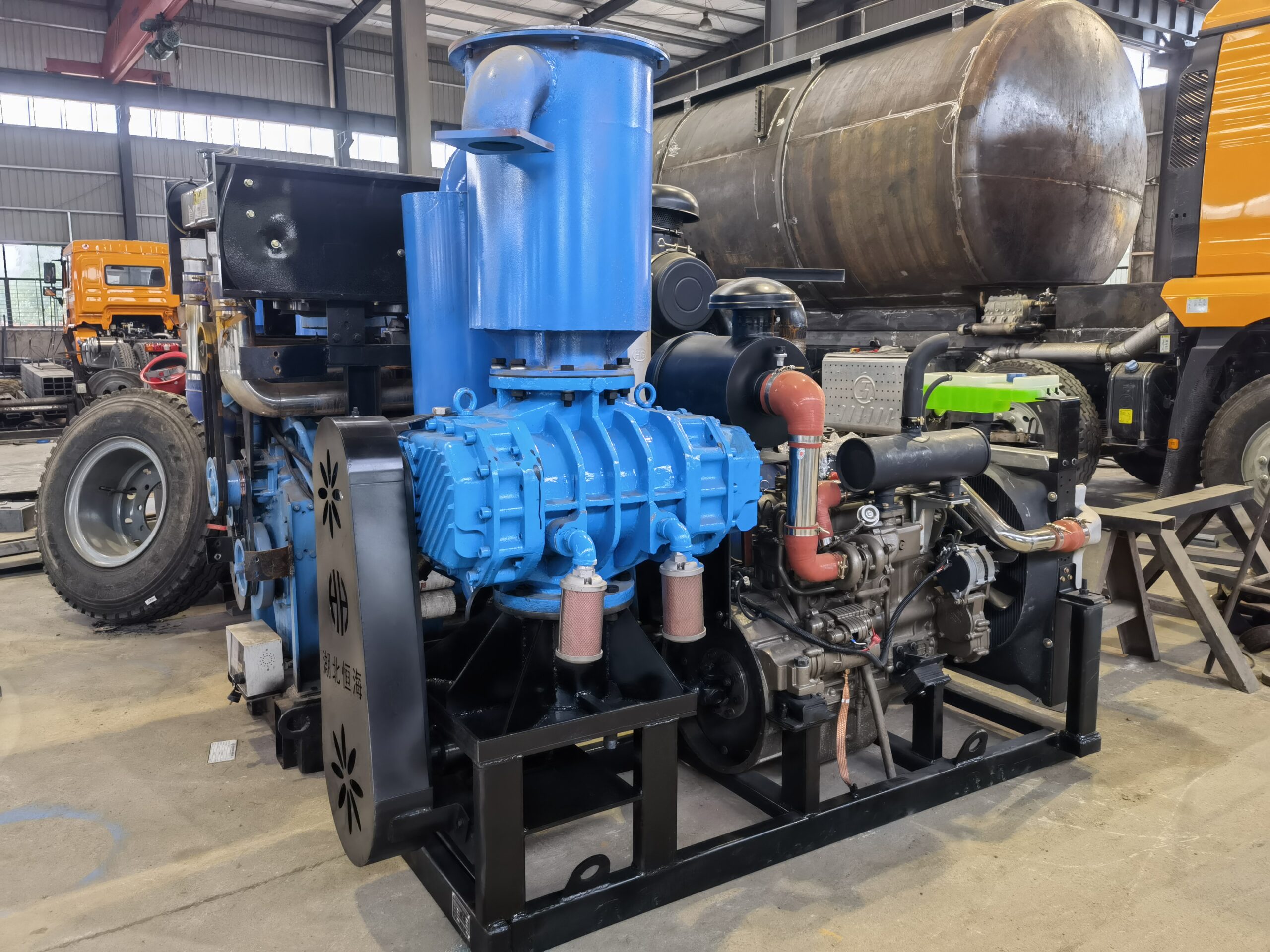
The workshop photo below shows a real Roots-type vacuum blower package during assembly. It illustrates the pump system and associated pipeline layout, not a universal configuration for every vacuum truck.
When we would look first at a Roots blower
We are more likely to discuss a Roots blower package when the project has several of these characteristics:
- The truck has a larger tank or a heavy-duty upper body and needs a high-output suction system.
- The working material is mainly collected through a large-diameter hose, and the route calls for serious air movement rather than only a small, light collection setup.
- The buyer needs a combined vacuum and jetting platform, with the suction side designed for regular recovery work after pipe cleaning.
- The fleet can follow the pump maker's maintenance schedule and keep filters, separators, belts or coupling arrangements in working condition.
- The final package has been reviewed for local temperature, dust, drainage and service conditions.
For example, the documented 17,000 L 6×6 Super Sucker reference on our site uses a Jurop Roots vacuum system specified at 4,150 m3/h. That figure describes a heavy-duty direction, but it should not be treated as a minimum requirement for every municipal vacuum truck. See Does Your Job Really Need a 6×6 Super Sucker Truck? for the working conditions behind that type of configuration.
What a liquid ring vacuum pump changes
A liquid ring vacuum pump uses a service liquid to form the working seal inside the pump. On vacuum trucks, this makes it a familiar option for wet suction duties where the pump package, cooling arrangement and service-water management are selected together.
That does not mean a liquid ring system is maintenance-free or suitable for every medium. The service liquid has to be managed, the pump must be protected from unsuitable solids, and the operating arrangement must be considered for the local climate and the available water supply. But for the right wet-duty application, a liquid ring package can be a stable, practical choice for continuous suction work.
The key distinction is not that one system is "modern" and the other is "old." They manage the suction process differently, so the best choice depends on the material and operating cycle.
When we would look first at a liquid ring system
A liquid ring vacuum pump becomes a strong option when the project needs sustained wet-material recovery and the operator can support the water, cooling and maintenance requirements of the package.
It is often worth discussing for:
- Sewage sludge, pond sludge, drainage sediment and other wet, non-hazardous recovery work
- Larger tank bodies or semi-trailer layouts that work for a long period at one site
- Projects where continuous suction stability matters more than a simple headline comparison of airflow
- Jobs where the buyer can confirm the service-liquid arrangement, drainage method and local operating temperature
- Heavy-duty configurations with the correct filters, relief devices, overflow protection and after-sales support
One documented reference on our site is a 25 m3 vacuum tank semi trailer fitted with a VTP3600 liquid ring vacuum pump, specified at 3,200 m3/h airflow and a stated vacuum level of 93%. The system also includes filtration, vacuum relief and overflow-protection components. Those details show why a pump cannot be judged on its name alone; the protection and tank arrangement are part of the working result.
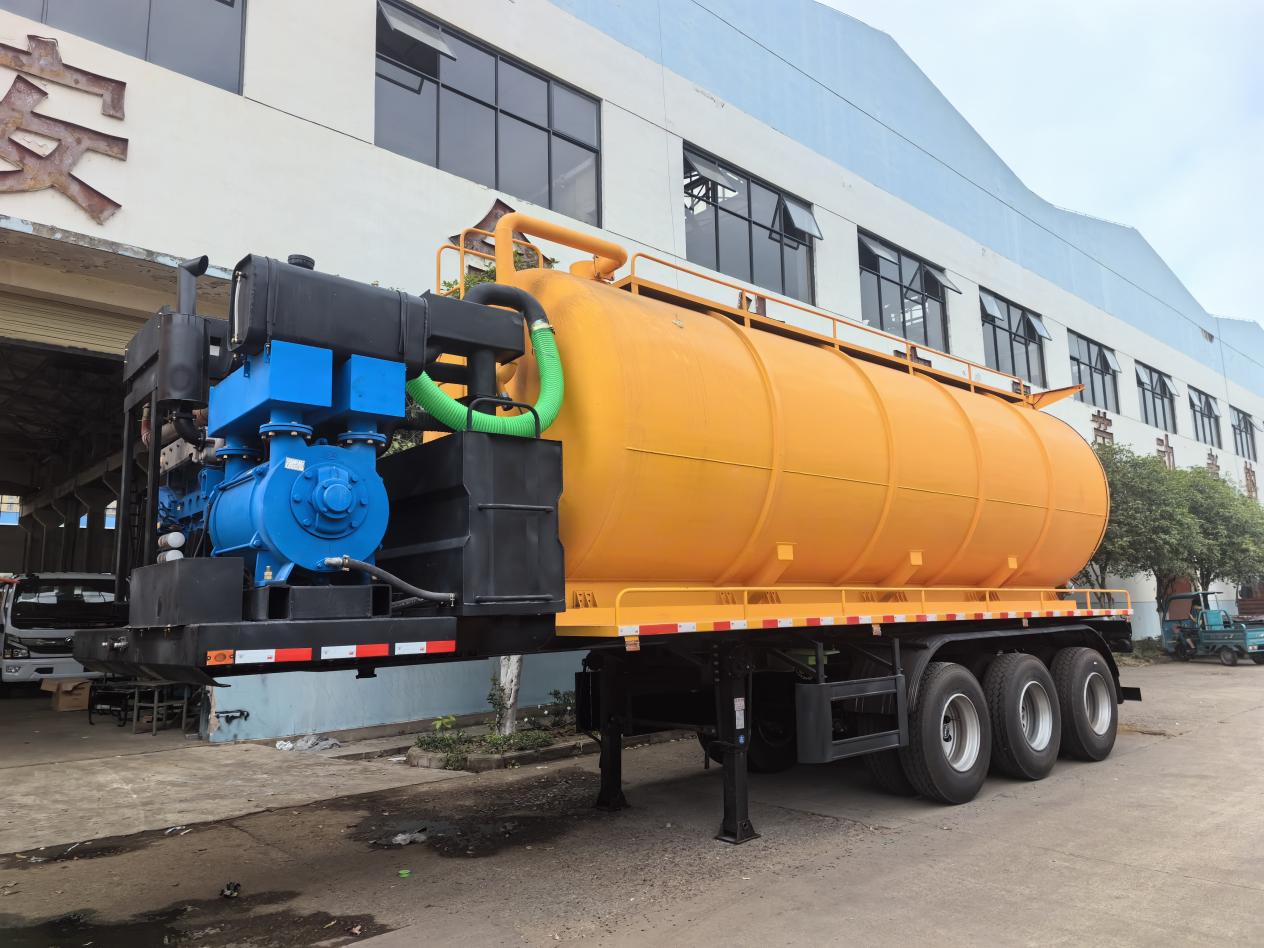
For the full reference configuration, see 25 m3 Semi-Trailer Vacuum Tank with VTP3600 Liquid Ring Pump.
A simple comparison: ask what happens during the shift
Instead of treating this as a brand comparison, it is more useful to think about what happens from the first hose connection to final discharge.
| Working question | Why it matters to the pump choice |
|---|---|
| What is being recovered? | Thin wastewater, wet sludge, sand-bearing slurry and industrial liquid place different demands on filtration, tank material and pump protection. |
| How long is the hose route? | Hose length, diameter, bends and vertical lift affect real suction performance more than a brochure figure alone. |
| How many hours will the truck work continuously? | Long site work and repeated recovery cycles need a pump package that can be maintained and operated consistently. |
| Is water management practical? | A liquid ring system needs its service-liquid arrangement to be considered from the start. |
| How hot, dusty or corrosive is the site? | Climate affects cooling, seals, coating, intake protection and the maintenance plan for either pump direction. |
| Who will maintain the truck? | A good pump choice becomes a poor one if filters, separators, service liquids and wear parts are not looked after. |
This is why two trucks with the same tank volume can need different vacuum systems. The working material and the operator's routine matter as much as the capacity figure.
Do not confuse the pump type with the whole truck specification
Choosing a Roots blower or liquid ring vacuum pump does not settle the rest of the build. The factory still needs to match the pump with:
- Tank material and coating: carbon steel, stainless steel or another protected arrangement based on corrosion risk.
- Suction and discharge pipeline: hose diameter, connection sizes, valves, sight glasses and the discharge method.
- Protection system: filters, separators, anti-overflow protection, pressure relief and level alarms.
- Drive and control layout: PTO direction, hydraulic or mechanical drives, control-box access and emergency stops.
- Chassis and payload: axle layout, road limits, climate, maintenance access and the loaded working condition.
For the wider system view, see Vacuum Tanks, Pumps & Spare Parts. For a vacuum-only truck reference, see 20 m3 Heavy-Duty Vacuum Suction Truck: What to Check Before Ordering.
The information that lets a factory make a useful recommendation
When you request a vacuum truck quotation, sending only a preferred pump name usually leads to a weaker recommendation. These details are more useful:
- Material to be recovered, including solids content, abrasiveness, temperature and corrosiveness
- Normal hose length, vertical suction lift and preferred hose diameter
- Expected daily working hours, recovery volume and disposal arrangement
- Whether the truck also needs high-pressure jetting, and the typical pipe-cleaning job
- Destination market, climate, road restrictions and preferred chassis support
- Who will perform routine service and what spare-parts support is available locally
With that information, we can decide whether a Roots blower, a liquid ring package or another vacuum direction is the sensible choice. The goal is not to specify the most impressive pump. It is to build a system the operator can use, maintain and rely on.
Frequently Asked Questions
Is a Roots blower always more powerful than a liquid ring vacuum pump?
No. Performance depends on the specific pump model, the complete suction system and the working conditions. Airflow figures should be compared only alongside hose size, lift, material, protection and duty cycle.
Is a liquid ring vacuum pump only for large semi trailers?
No. Liquid ring systems can be used in different vehicle and tank layouts. A semi trailer is simply one documented reference. The right layout depends on capacity, access, chassis and the working route.
Which pump is better for hot climates?
There is no single answer. The pump package, cooling or service-liquid arrangement, intake protection and maintenance plan all need to be reviewed for the actual temperature, dust and operating hours. Climate should be part of the specification, not an afterthought.
Can the same truck use both a vacuum system and high-pressure jetting system?
Yes. A combined truck can be configured with both. The pump, PTO arrangement, clean-water capacity, hose reel and recovery duty must be designed as one working package.
What should I send before asking for a pump recommendation?
Send the material, tank capacity, hose route, expected work hours, cleaning requirement, climate and destination market to CLW Group. That is enough to begin a practical system discussion.